

How EtherFi Migrated $220M to Optimism With Veda
EtherFi needed to change chains without interrupting 300,000 accounts
Moving a live financial product from one blockchain to another is significantly more complex than deploying a new application.
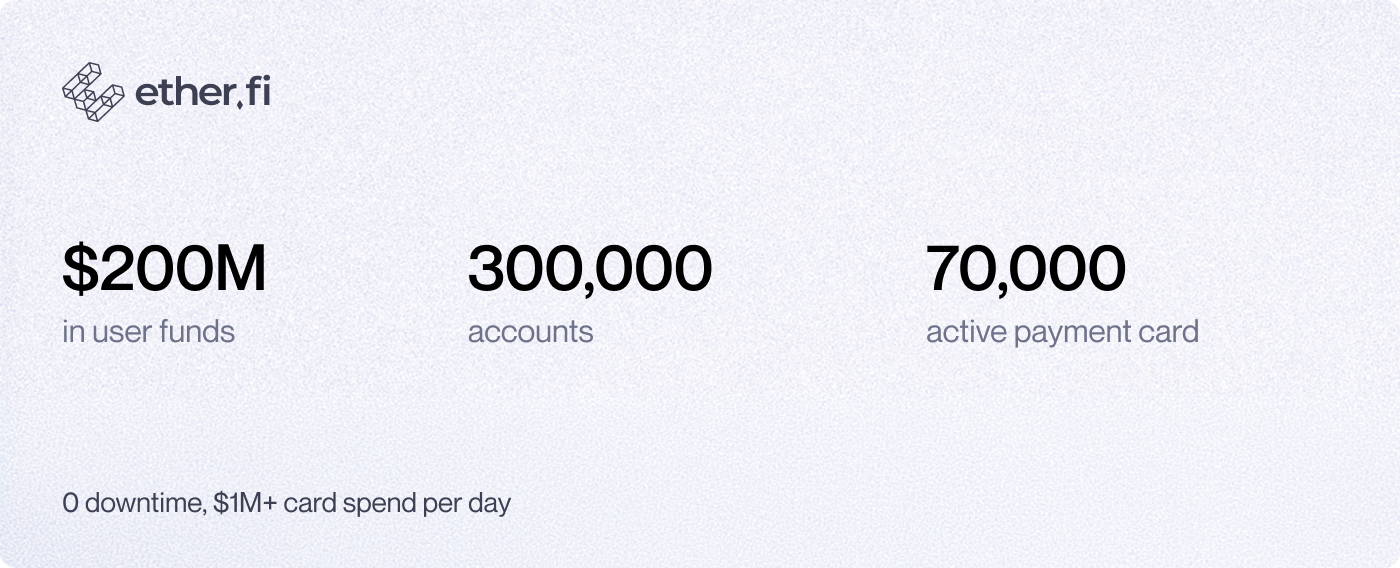
EtherFi needed to migrate six production vaults and their receipt tokens from Scroll to Optimism through Ethereum mainnet. The move affected approximately $220 million in user funds, 300,000 accounts, and 70,000 active payment cards.
Throughout the migration, EtherFi needed to preserve:
- Continuous card payments
- User access to deposits and withdrawals
- Accurate onchain ownership and balance records
- Non-custodial control of customer assets
- Secure coordination across Scroll, Ethereum, and Optimism
A conventional migration could have required products to be paused, positions to be unwound, or customers to take action. Any of those outcomes would have introduced friction and operational risk.
For EtherFi, downtime was not an option. Its customers were processing more than $1 million in card transactions per day during the migration period.
Veda made crosschain migration an infrastructure operation—not a user event
Veda worked with EtherFi to move its vault infrastructure across three blockchains while keeping the customer experience unchanged.
Rather than closing existing positions and asking users to redeposit, Veda’s architecture enabled vault receipt tokens to move to corresponding vaults on Optimism. These tokens remained the onchain record connecting each depositor to their balance throughout the migration.
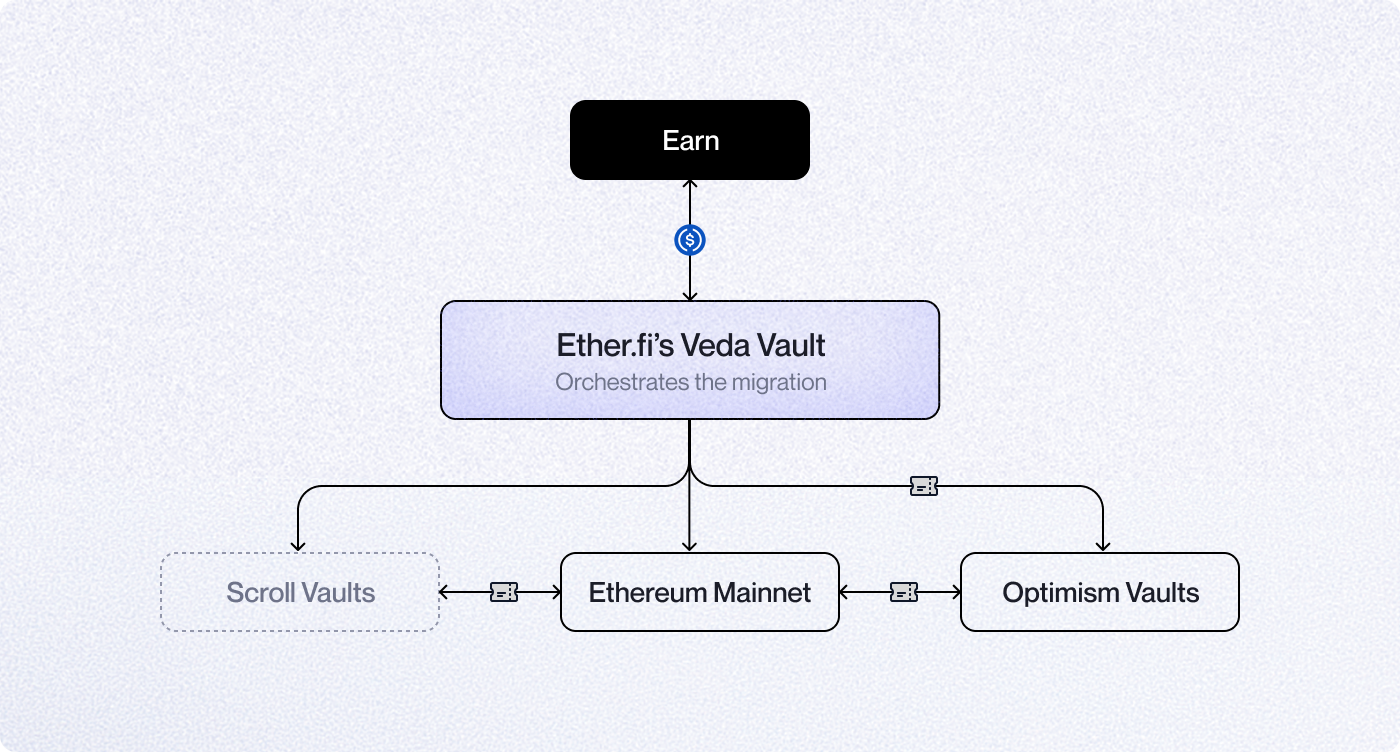
The coordinated migration included:
- Deploying five new Optimism vaults for sETHFI, eBTC, eUSD, LiquidUSD, and LiquidBTC.
- Reconfiguring EtherFi’s existing LiquidETH vault on Optimism with new modules.
- Enabling deposits, withdrawals, and receipt-token bridging across all six vaults.
- Establishing asset-bridging routes from Scroll through Ethereum mainnet to Optimism.
- Increasing bridge rate limits temporarily to accommodate the migration volume.
- Moving vault receipt tokens securely across all three chains.
- Returning rate limits to standard operating levels once the migration was complete.
- Beginning the controlled deprecation of EtherFi’s previous Scroll vault deployments.
Throughout the process, Veda generated and executed complex crosschain transactions and reviewed EtherFi-originated transactions before execution. EtherFi’s curators then moved the underlying assets along the same route.
Infrastructure designed for change
Four capabilities of Veda’s vault stack made the migration possible:


$220 million moved with no downtime and no customer action
Veda and EtherFi completed the migration in less than three days.
During that time:
- Approximately $220 million in user funds moved successfully.
- 300,000 accounts transitioned to the new infrastructure.
- 70,000 active EtherFi Cash cards remained operational.
- Cardholders continued processing more than $1 million in daily transactions.
- Deposits and withdrawals remained available.
- Customers did not need to bridge, migrate, or redeposit assets themselves.
- No customer-facing downtime was required.
For EtherFi users, nothing appeared to change. Their cards continued to work, their funds remained accessible, and their balances stayed intact while the infrastructure beneath the product moved from one ecosystem to another.
For EtherFi, the migration delivered a more cost-effective blockchain foundation without sacrificing continuity or control.
For Veda, it demonstrated that blockchain choice does not need to become a permanent infrastructure constraint.
Institutional observers who run compliance desks and treasury operations at scale saw $220M move cleanly and flagged it as remarkable: no incident report, no customer communication, no ‘we apologize for the inconvenience.
Why flexible vault infrastructure matters
Blockchain conditions change. Fees increase, liquidity shifts, new networks emerge, and existing ecosystems lose momentum.
Enterprises offering onchain financial products need infrastructure that can adapt without forcing them to rebuild their products—or transfer the complexity of a migration to their customers.
With Veda, companies can preserve the flexibility to:
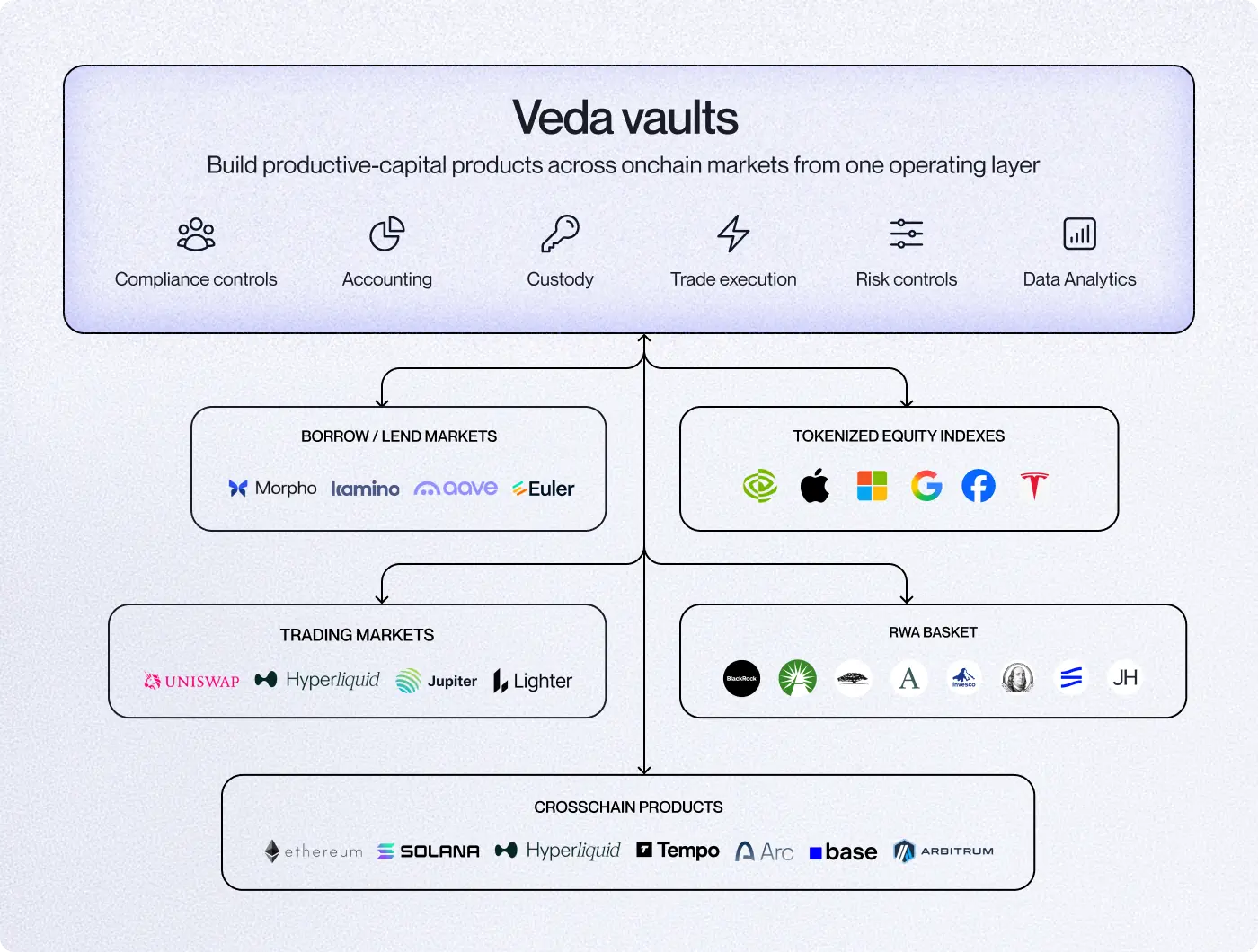
Crosschain migration becomes a built-in operational capability instead of a multi-month engineering project.
The bottom line
Veda gives fintechs, exchanges, asset managers, and other enterprises the vault infrastructure they need to build onchain financial products that can evolve without disrupting their users.
- Approximately $220 million in user funds moved successfully.
- 300,000 accounts transitioned to the new infrastructure.
- 70,000 active EtherFi Cash cards remained operational.
- Cardholders continued processing more than $1 million in daily transactions.
- Deposits and withdrawals remained available.
- Customers did not need to bridge, migrate, or redeposit assets themselves.
- No customer-facing downtime was required.
To build embedded Earn into your platform, reach out for a free vault design consultation.
Frequently asked questions
Looking for a vault design partner?
Veda helps institutions build secure, scalable yield products. Tell us what you're building and we'll follow up.