
The Enterprise Earn Stack: Building the Infrastructure for Onchain Yield

Digital assets are moving beyond their origins as purely speculative instruments.
Stablecoins are becoming embedded in financial products. Tokenized assets are expanding the range of opportunities available onchain. And as digital assets become more integrated into the financial system, customers increasingly expect to do more than simply hold them.
They expect to earn.
For fintechs, neobanks, exchanges, brokerages, and other financial institutions, that creates an opportunity. It also creates a much harder infrastructure problem than the simplicity of the end product suggests.
An Earn product is simple. The infrastructure behind it isn’t.
To the customer, an Earn experience should feel familiar: deposit an asset, select an opportunity, and begin earning.
Behind that interface sits an entirely different reality.
Institutions need to determine which assets they will support, identify and evaluate sources of yield, allocate capital, manage liquidity and risk, integrate with protocols and networks, monitor positions, and adapt as market conditions change.
And the complexity compounds over time.
New assets emerge. Yield opportunities change. Liquidity moves. Risk profiles evolve. Networks and protocols multiply. What began as a single product can quickly become an operating model that has to continuously adapt.
The challenge, then, isn’t simply connecting an institution to a source of yield.
It’s building infrastructure that can support a changing set of opportunities while preserving a consistent Earn product.
A stack, not a single integration
We think about that infrastructure as the Enterprise Earn Stack.
Rather than treating Earn as one vertically integrated product, the stack separates it into four distinct layers:
Distributors own the customer experience and determine how users access Earn.
Vaults provide the connective infrastructure between that experience and the underlying sources of yield.
Curators provide the strategy and risk-management layer, determining how capital should be allocated across opportunities.
Protocols are where yield is ultimately generated across an expanding digital asset ecosystem.
Separating these functions matters.
It means the institution providing the customer experience does not also have to become an expert in every protocol, network, strategy, and source of yield beneath it. Each participant can specialize, while the infrastructure connecting them remains composable.
The result is an Earn architecture that can be non-custodial, network- and asset-agnostic, modular, and capable of evolving alongside the market.
Building for what comes next
The digital asset ecosystem will not become simpler by standing still.
More assets will move onchain. More networks will emerge. New strategies and sources of yield will develop. And institutions will need a way to participate without rebuilding their Earn products every time the opportunity set changes.
That requires thinking beyond the individual integration.
In The Enterprise Earn Stack, we break down the infrastructure behind institutional Earn products: how each layer works, where different participants fit, how capital moves through the stack, and why modular infrastructure matters as the digital asset ecosystem expands.
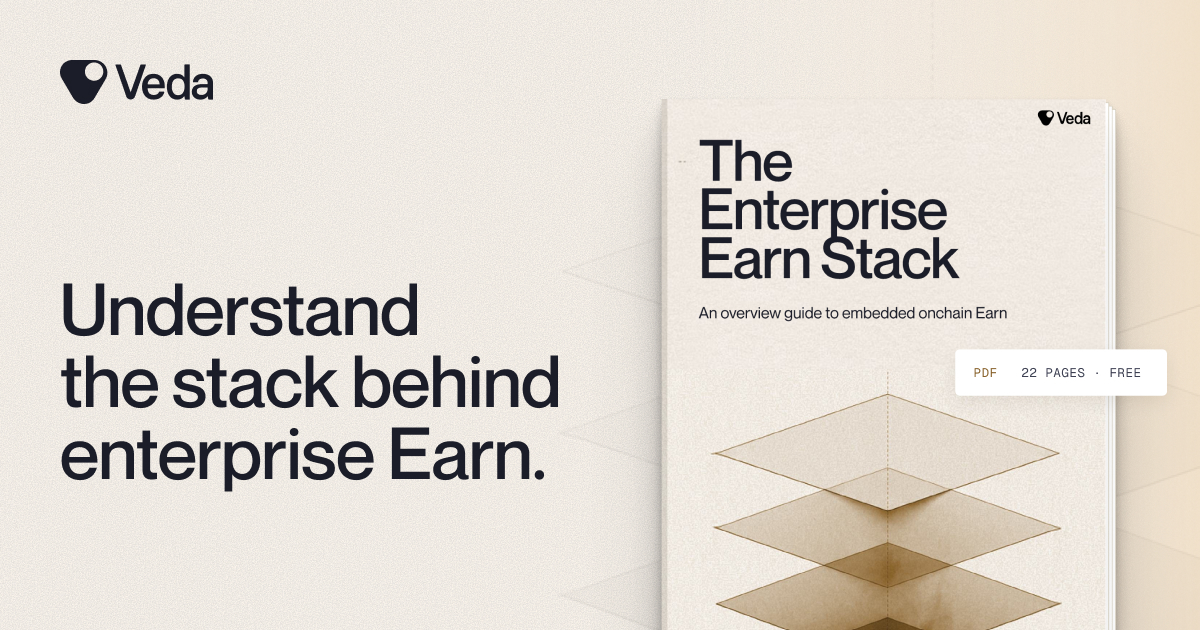
Download The Enterprise Earn Stack to explore the full framework.
More From Blog

Modular Assets: The Future of DeFi

Turning Idle Capital into Ecosystem Bootstrapping