
Learn

2 Years of Building Multichain Vault Tech: The Veda Story

Team Veda
·
July 6, 2026

Over two years ago, we started Veda with a simple conviction: Onchain yield and vault infrastructure will power the next iteration of our financial system. That called for flexible architecture able to scale into that future.

Today, it’s been over two years since Veda began operating the first multichain vaults,  and it’s been two and a half years since we started on our mission. 

Why we started Veda

Our cofounders began by founding Seven Seas, the industry’s first vault curator operating at scale. But we quickly realized that existing infrastructure didn’t allow us to offer more sophisticated strategies or give us the flexibility we needed for the best possible onchain yield experience. At the time, there wasn’t any solution in the market that supported multichain, multiprotocol yield strategies, especially at the scale required by institutions. During this phase, we saw a clear need for modular, non-custodial vaults with compliance and risk controls that solve real enterprise pain points.

Our company mission is to make capital productive onchain. We believe the real unlock for institutional adoption lives between the end user and the protocol, where vaults turn the permissionless financial landscape into yield opportunities that product teams can actually use. 

Today, that conviction has only gotten stronger.
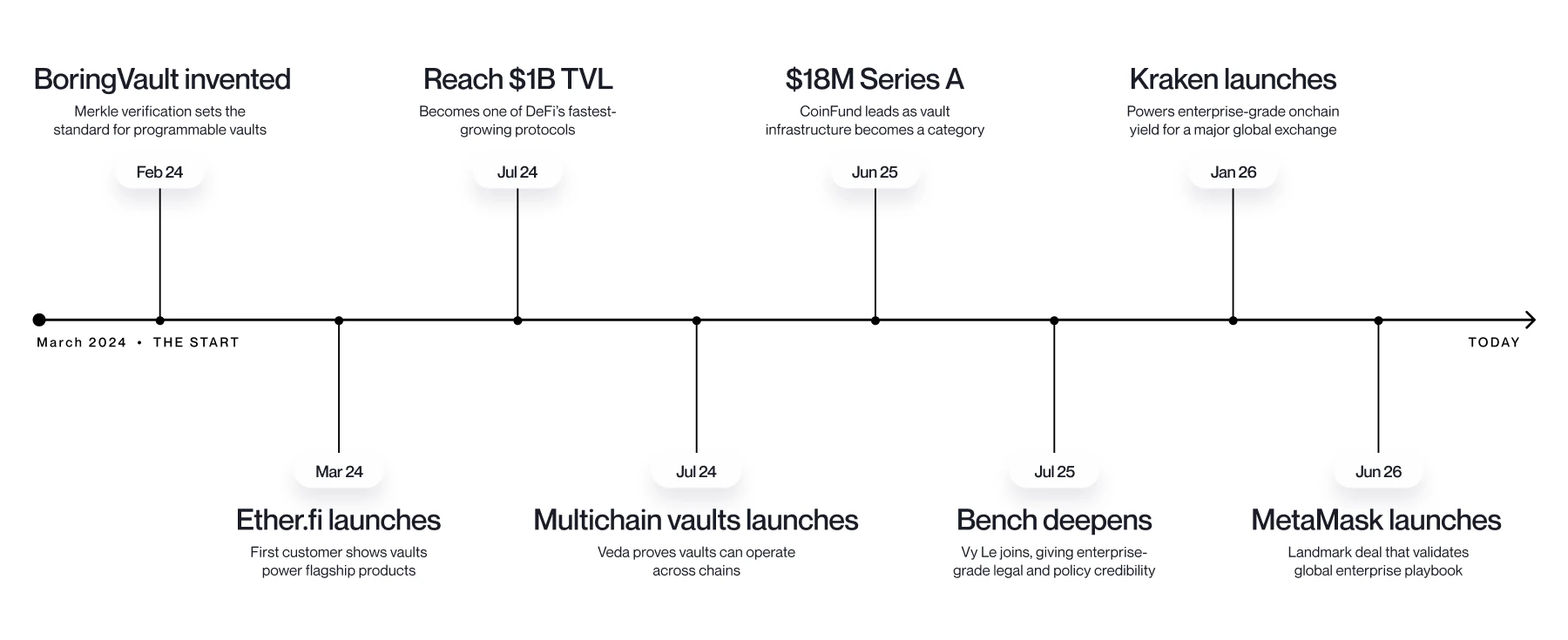
We invented the BoringVault standard and developed a key innovation to leverage Merkle verification for vaults.

This cryptographic method is foundational to the security architecture our vaults use to verify every action and limit smart contract risk exposure. We deployed the first multichain vaults, helping teams launch products that give enterprises and risk managers the tools they need to deliver institutional-grade, multiprotocol yield at scale.
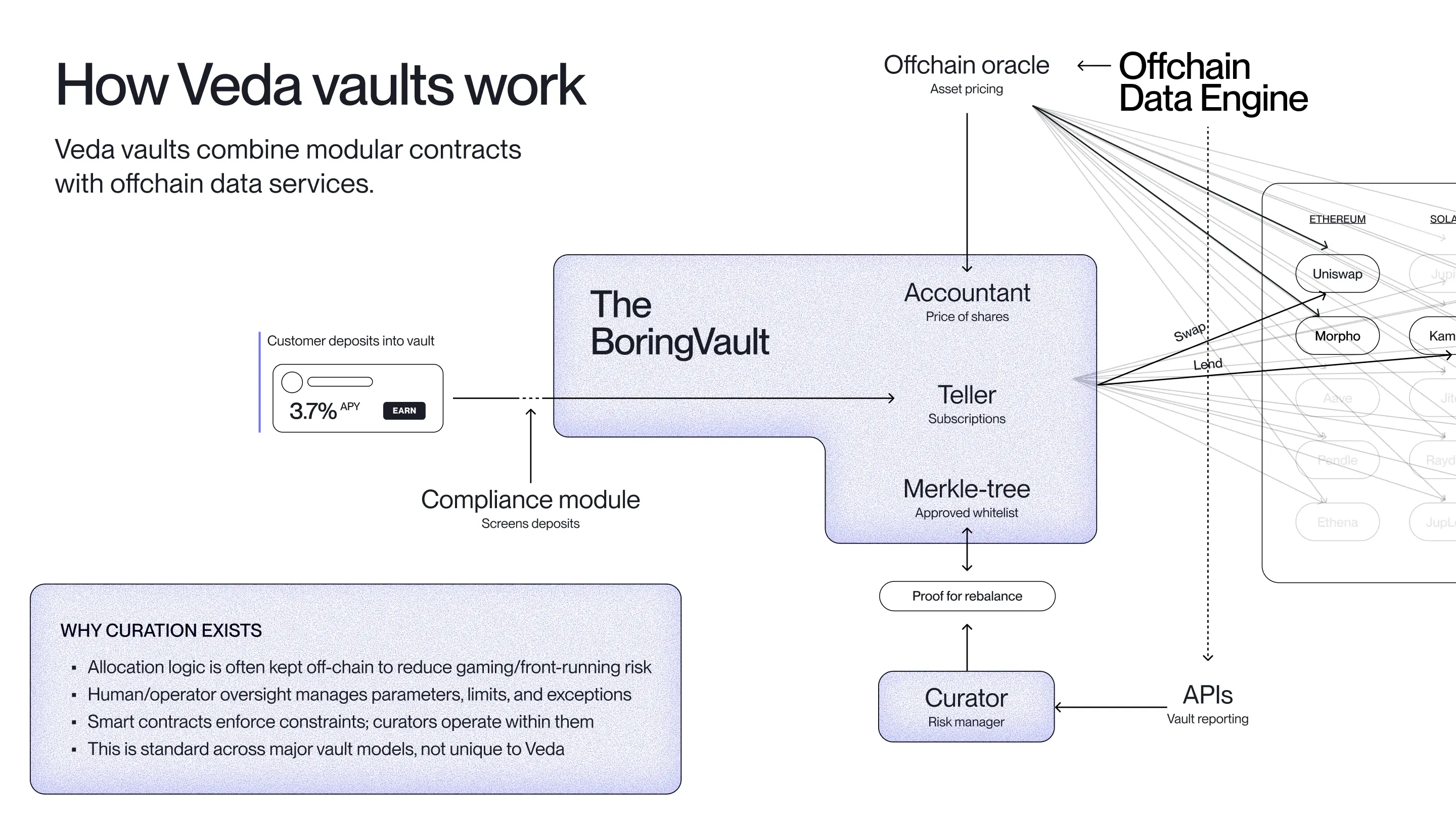
The BoringVault’s invention accelerated yield product go-to-market timelines and shortened them by months. For example, adding a new protocol used to take teams a month via the adapter method. Today, it only takes a few days with a Veda BoringVault. This has allowed teams to push feature updates and launch new products in shorter timeframes.

Proving the thesis

In May 2024, our versatile vault design enabled EtherFi to launch a suite of DeFi yield opportunities for its users including yield on ETH, BTC, and USDC. Veda now powers 7 vaults for EtherFi, which have collectively processed over $2.1 billion in deposits to date for more than 165,000 lifetime users, generating over $74 million in yield. 

The EtherFi Veda vaults first surpassed $1 billion in deposits in July 2024, just two months after the integration’s launch, showing significant demand and a market resurgence in interest. Prior to this launch, it had been years since any DeFi vault protocol had achieved such growth (the prior had been Yearn before its decline in 2022). The Veda-EtherFi partnership succeeded in elevating vault products to new heights and proving their suitability for neobanks, all while upholding the necessary security, risk, and compliance controls.

EtherFi’s success shows that vaults work at scale when distributed through enterprise partners, proving our B2B thesis. This integration established whitelabeled vaults within apps as the market standard, and Coinbase’s USDC Earn Morpho integration launched over half a year later in early 2025.

In June 2025, we raised an $18 million Series A led by Coinfund, with participation from Coinbase Ventures, GSR, Maelstrom, BitGo, and others — the largest raise for a vault protocol in years. Our investors also include over 50 angels from across the industry, including leaders from EtherFi, Anchorage, Polygon, and more.

Since then, we’ve worked with Kraken, MetaMask, Plasma, Whop, and others, and expanded our infrastructure to support both EVM and SVM integrations. As one of the fastest-growing protocols launched in the past three years, we’ve been able to repeatedly deliver on enterprise demand for meaningful yield on stablecoins, staked assets, bitcoin, and other digital assets. 

This year, we launched the four vaults that underpin Kraken’s DeFi Earn Vaults product, which has seen more than 90,000 lifetime users and over $530 million in deposits. The Kraken USDC vaults deliver industry-leading stablecoin yield with up to 6% APY without incentives. In many ways, Kraken has become the gold standard for DeFi Vault integrations because it serves as a model for how enterprises can leverage multichain, multiprotocol vaults to adapt yield strategies over time for higher yields on stablecoin deposits. 

Following Kraken, we enabled the internet marketplace Whop to launch onchain yield for millions of businesses and users with Whop Treasury and Finance, features that use an embedded Veda vault to deliver dollar-denominated yield.

With EtherFi, our vault stack facilitated a seamless crosschain migration this year as the neobank moved to a new blockchain in less than three days while maintaining continuous uptime for its 70,000 payment cards.

For Plasma, we enabled earning yield on Tether’s USDT stablecoin within the Plasma One app while letting over 10,000 users spend on their Earn balances with their Plasma Visa payment cards netting nearly 100k transactions since launch. 

And most recently, MetaMask, which has over 100 million users, selected Veda to power its Money Account vault infrastructure, enabling earning on the mUSD stablecoin within the world’s leading self-custodial wallet.  

The next evolution

Today, institutions are moving onchain more than ever before, with many launching their own stablecoins, bootstrapping new blockchains, tokenizing real-world assets, and looking to offer their clients meaningful yield with strategies and infrastructure that can adapt to market shifts. 

With the total global stablecoin market cap exceeding $320 billion, we see an immense opportunity to power onchain yield on any asset at scale. Non-custodial vaults are the ideal solution for making stablecoins productive because they provide the necessary security controls while remaining flexible enough to adapt to changing markets.

The financial system is evolving, and the infrastructure layer is becoming more important than ever. While the permissionless power of DeFi is undeniable, it poses an array of compliance, security, and execution challenges for institutions. Because of this, vaults are the only way institutions can safely engage with DeFi while meeting their compliance and risk requirements. 

There’s never been a better time to be building in DeFi. Now, more than ever before, DeFi can be made accessible and invaluable to millions of everyday consumers and businesses with idle stablecoins, crypto, or RWAs that aren’t earning for them. With vaults, the vast world of onchain finance can be simplified into risk-adjusted yield opportunities that keep users onchain and on-platform. 

Our approach puts security, transparency, and flexibility at the forefront, with every vault showing where user funds are onchain while enforcing key security features at every step in the process. 

Since Veda began, our vaults have processed over $16.5 billion in deposits for 300,000 lifetime users. 

To our partners: Thank you for trusting us with the most critical layer of your product stack. That trust isn't something we take lightly.

Today we’re exactly where we want to be — building at the frontier, alongside the teams who are leading it.

Here's to what's next.

SHARE
Team Veda
KEEP READING
More from the blog
Partnerships
News
Veda Powers MetaMask Money Account, Enabling Yield for Leading Self-Custodial Wallet
Spendable stablecoin yield is now available in MetaMask.
Team Veda
·
June 2026
·
Read article →
Policy
News
Veda and Bluprynt Submit SEC Letter on Custody Regulation
Digital asset custody rules should focus on protections delivered.
Team Veda
·
June 2026
·
3 minutes
Read article →
Partnerships
News
Plasma One Powers Stablecoin Earn With Veda
A new Veda vault enables spendable USDT yield.
Team Veda
·
June 2026
·
4 minutes
Read article →
NEWSLETTER
Subscribe to our newsletter
The latest news on Veda and vaults, straight to your inbox.
Thank you! Your submission has been received!
Oops! Something went wrong while submitting the form.
Thanks for submitting the form.
NO SPAM. UNSUBSCRIBE ANY TIME.

2 Years of Building Multichain Vault Tech: The Veda Story

July 2026

Our journey from early curators to operating DeFi vaults at billion-dollar scale.

Over two years ago, we started Veda with a simple conviction: Onchain yield and vault infrastructure will power the next iteration of our financial system. That called for flexible architecture able to scale into that future.

Today, it’s been over two years since Veda began operating the first multichain vaults,  and it’s been two and a half years since we started on our mission. 

Why we started Veda

Our cofounders began by founding Seven Seas, the industry’s first vault curator operating at scale. But we quickly realized that existing infrastructure didn’t allow us to offer more sophisticated strategies or give us the flexibility we needed for the best possible onchain yield experience. At the time, there wasn’t any solution in the market that supported multichain, multiprotocol yield strategies, especially at the scale required by institutions. During this phase, we saw a clear need for modular, non-custodial vaults with compliance and risk controls that solve real enterprise pain points.

Our company mission is to make capital productive onchain. We believe the real unlock for institutional adoption lives between the end user and the protocol, where vaults turn the permissionless financial landscape into yield opportunities that product teams can actually use. 

Today, that conviction has only gotten stronger.

We invented the BoringVault standard and developed a key innovation to leverage Merkle verification for vaults.

This cryptographic method is foundational to the security architecture our vaults use to verify every action and limit smart contract risk exposure. We deployed the first multichain vaults, helping teams launch products that give enterprises and risk managers the tools they need to deliver institutional-grade, multiprotocol yield at scale.

The BoringVault’s invention accelerated yield product go-to-market timelines and shortened them by months. For example, adding a new protocol used to take teams a month via the adapter method. Today, it only takes a few days with a Veda BoringVault. This has allowed teams to push feature updates and launch new products in shorter timeframes.

Proving the thesis

In May 2024, our versatile vault design enabled EtherFi to launch a suite of DeFi yield opportunities for its users including yield on ETH, BTC, and USDC. Veda now powers 7 vaults for EtherFi, which have collectively processed over $2.1 billion in deposits to date for more than 165,000 lifetime users, generating over $74 million in yield. 

The EtherFi Veda vaults first surpassed $1 billion in deposits in July 2024, just two months after the integration’s launch, showing significant demand and a market resurgence in interest. Prior to this launch, it had been years since any DeFi vault protocol had achieved such growth (the prior had been Yearn before its decline in 2022). The Veda-EtherFi partnership succeeded in elevating vault products to new heights and proving their suitability for neobanks, all while upholding the necessary security, risk, and compliance controls.

EtherFi’s success shows that vaults work at scale when distributed through enterprise partners, proving our B2B thesis. This integration established whitelabeled vaults within apps as the market standard, and Coinbase’s USDC Earn Morpho integration launched over half a year later in early 2025.

In June 2025, we raised an $18 million Series A led by Coinfund, with participation from Coinbase Ventures, GSR, Maelstrom, BitGo, and others — the largest raise for a vault protocol in years. Our investors also include over 50 angels from across the industry, including leaders from EtherFi, Anchorage, Polygon, and more.

Since then, we’ve worked with Kraken, MetaMask, Plasma, Whop, and others, and expanded our infrastructure to support both EVM and SVM integrations. As one of the fastest-growing protocols launched in the past three years, we’ve been able to repeatedly deliver on enterprise demand for meaningful yield on stablecoins, staked assets, bitcoin, and other digital assets. 

This year, we launched the four vaults that underpin Kraken’s DeFi Earn Vaults product, which has seen more than 90,000 lifetime users and over $530 million in deposits. The Kraken USDC vaults deliver industry-leading stablecoin yield with up to 6% APY without incentives. In many ways, Kraken has become the gold standard for DeFi Vault integrations because it serves as a model for how enterprises can leverage multichain, multiprotocol vaults to adapt yield strategies over time for higher yields on stablecoin deposits. 

Following Kraken, we enabled the internet marketplace Whop to launch onchain yield for millions of businesses and users with Whop Treasury and Finance, features that use an embedded Veda vault to deliver dollar-denominated yield.

With EtherFi, our vault stack facilitated a seamless crosschain migration this year as the neobank moved to a new blockchain in less than three days while maintaining continuous uptime for its 70,000 payment cards.

For Plasma, we enabled earning yield on Tether’s USDT stablecoin within the Plasma One app while letting over 10,000 users spend on their Earn balances with their Plasma Visa payment cards netting nearly 100k transactions since launch. 

And most recently, MetaMask, which has over 100 million users, selected Veda to power its Money Account vault infrastructure, enabling earning on the mUSD stablecoin within the world’s leading self-custodial wallet.  

The next evolution

Today, institutions are moving onchain more than ever before, with many launching their own stablecoins, bootstrapping new blockchains, tokenizing real-world assets, and looking to offer their clients meaningful yield with strategies and infrastructure that can adapt to market shifts. 

With the total global stablecoin market cap exceeding $320 billion, we see an immense opportunity to power onchain yield on any asset at scale. Non-custodial vaults are the ideal solution for making stablecoins productive because they provide the necessary security controls while remaining flexible enough to adapt to changing markets.

The financial system is evolving, and the infrastructure layer is becoming more important than ever. While the permissionless power of DeFi is undeniable, it poses an array of compliance, security, and execution challenges for institutions. Because of this, vaults are the only way institutions can safely engage with DeFi while meeting their compliance and risk requirements. 

There’s never been a better time to be building in DeFi. Now, more than ever before, DeFi can be made accessible and invaluable to millions of everyday consumers and businesses with idle stablecoins, crypto, or RWAs that aren’t earning for them. With vaults, the vast world of onchain finance can be simplified into risk-adjusted yield opportunities that keep users onchain and on-platform. 

Our approach puts security, transparency, and flexibility at the forefront, with every vault showing where user funds are onchain while enforcing key security features at every step in the process. 

Since Veda began, our vaults have processed over $16.5 billion in deposits for 300,000 lifetime users. 

To our partners: Thank you for trusting us with the most critical layer of your product stack. That trust isn't something we take lightly.

Today we’re exactly where we want to be — building at the frontier, alongside the teams who are leading it.

Here's to what's next.

Interested in integrating vaults? 

CONTACT US

Learn more about Veda